YOUR GO TO PLACE FOR EVERYTHING WOMEN'S FOOTBALL!

From BUCS Finals to the National League: How University Football is Powering the Women’s Game
A dramatic stoppage-time winner decided the BUCS Women’s National Championship, but the story goes far beyond the final whistle. We spoke to Anna Pitt and Emma Hunt to explore the growing link between university football and the FAWNL...
FEATURE ARTICLES
4/8/20263 min read


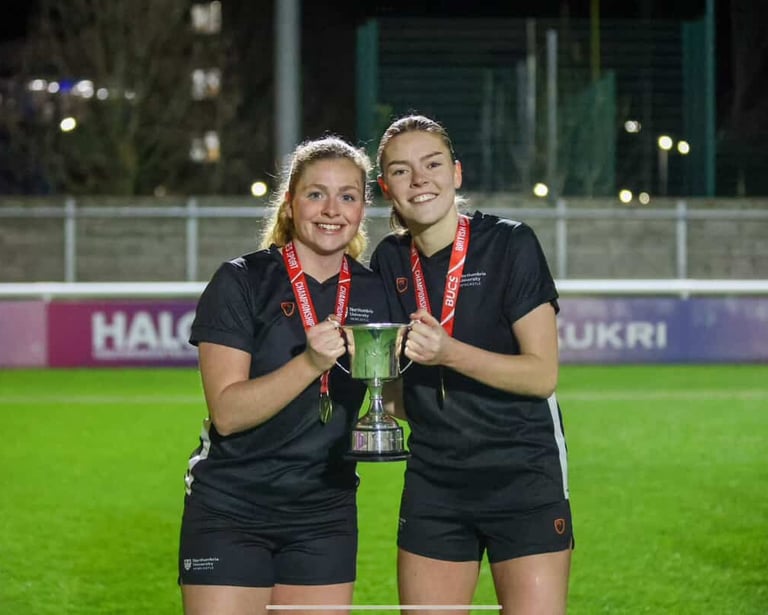
Under the pressure of a national final and the fading light of stoppage time, the BUCS Women’s National Championship delivered a moment that captured everything compelling about university football. The University of Northumbria sealed a dramatic 2-1 victory over the University of Nottingham, a match defined not just by its late winner, but by the quality and experience on display across the pitch.
Increasingly, BUCS competitions are becoming a meeting point for players who are also competing week in, week out in the FAWNL with the line between student and semi-professional footballer very much intertwined.
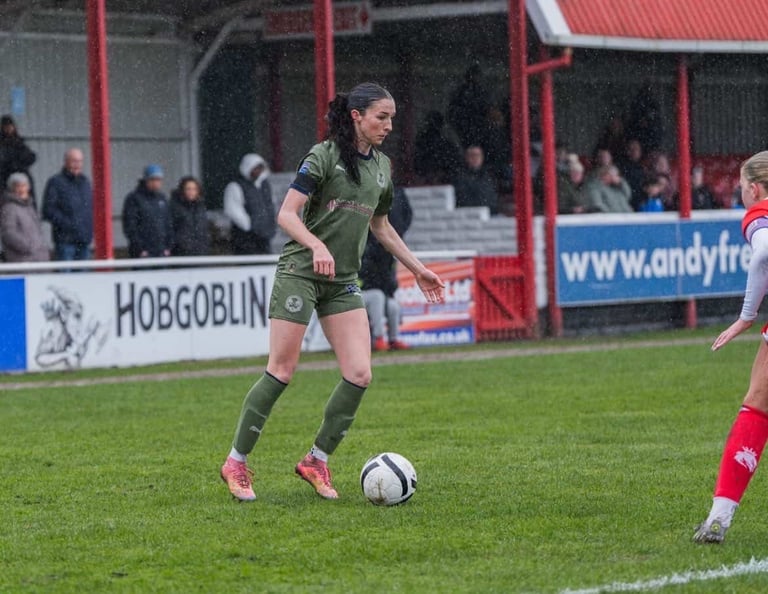
We spoke to two players who embodied that connection in the final: Anna Pitt, a first-team player and American scholar for the University of Nottingham and Peterborough United, and Emma Hunt, part of the title-winning Northumbria side and a Chester-le-Street Town player.
Their journeys offer a clear insight into how university football and the National League are not separate pathways but complementary forces shaping the modern women’s game.
Two Environments, One Standard
For Pitt, the contrast between the two levels lies in the type of challenge each presents. “The biggest differences are the intensity and level of experience,” she explains. “In the FA Women’s National League, you come up against players from a wide range of backgrounds… so the game tends to be more demanding.”
Yet BUCS football is far from a step down. “It’s still extremely competitive,” Pitt adds, “but contains that youth athleticism… sometimes it can feel rushed with players who may not have that longer experience.”
Hunt echoes that sentiment, but from a slightly different perspective. “In terms of intensity I would definitely say BUCS is more demanding and is a quicker style of play,” she says. “But the National League is more physical… there’s obviously a lot more experience.”
What becomes clear is that neither environment is “higher” or “lower” in a simple sense. Instead, they challenge players in different ways, technically, physically and tactically, creating more complete footballers.
Photography by Hannah Jean
The Demands Behind the Scenes
Behind the performances, however, lies a demanding reality.
Balancing university football with National League commitments is not for the faint-hearted. Players often face two matches a week, layered on top of training, academic work and in many cases, part-time jobs.
“The biggest challenge is managing both the physical and mental demands,” Pitt says. “You might have an important FAWNL game on the Sunday and then be preparing for a big BUCS fixture on the Wednesday.”
Hunt paints an equally intense picture. “Physically it’s playing two games a week and training every night… and alongside that, I still have uni work and a part-time job,” she explains. “You just have to be organised.”
Both players highlight the same essentials: recovery, communication with coaches and elite-level time management, skills that mirror those required at the highest levels of the sport.
Development Through Dual Exposure
If the schedule is demanding, the rewards are equally significant.
For the American, the dual environment has accelerated her all-round development. She explained that the “FAWNL has improved my physicality and decision-making under pressure… while BUCS has given me more opportunities to express myself and develop technically,” she says.
Hunt agrees, emphasising the tactical growth that comes from adapting between two styles of play. “Because I play differently in university football compared to the National League, it has improved my tactical understanding and made me more adaptable.”
This constant switching, between speed and physicality, structure and freedom, is producing smarter, more versatile players.
A Two-Way Pathway
Perhaps the most important takeaway is how closely linked the two systems have become.
“I think university football can be an important pathway,” Pitt says. “There’s been a lot of crossover — I met my FAWNL coach through university football.”
Hunt is just as clear about the connection. “Uni football does feed into the National League,” she explains. “Being involved in both gives you the best of both worlds.”
Their stories reflect a growing trend: university football is no longer just a place to keep playing but ia genuine platform for progression and networking within the women’s game.
Shaping Ambition
That connection is also shaping how players see their futures.
For Hunt, success on the BUCS stage, including that dramatic national title win, has reinforced her belief. “It’s given me the confidence that I can keep pushing myself within the National League and hopefully progress even further.”
On the other hand, for Pitt, university football reignited her drive after injury setbacks. “It helped me realise how much I love playing… and pushed me to pursue the opportunity to play in the FAWNL.”
Passion
Our passion is everything women's football but we are aiming specifically to shine a light on the amount of talent that is present within the lower leagues of the Women's game in England
Contact us at
Community
Email: Twoontheballwoso@gmail.com
Instagram: @twoontheball
TikTok: @twoontheball
© 2025. All rights reserved.